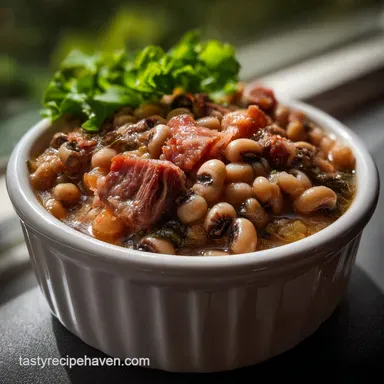
Southern Black Eyed Peas Recipes: a Savory Umami Bomb
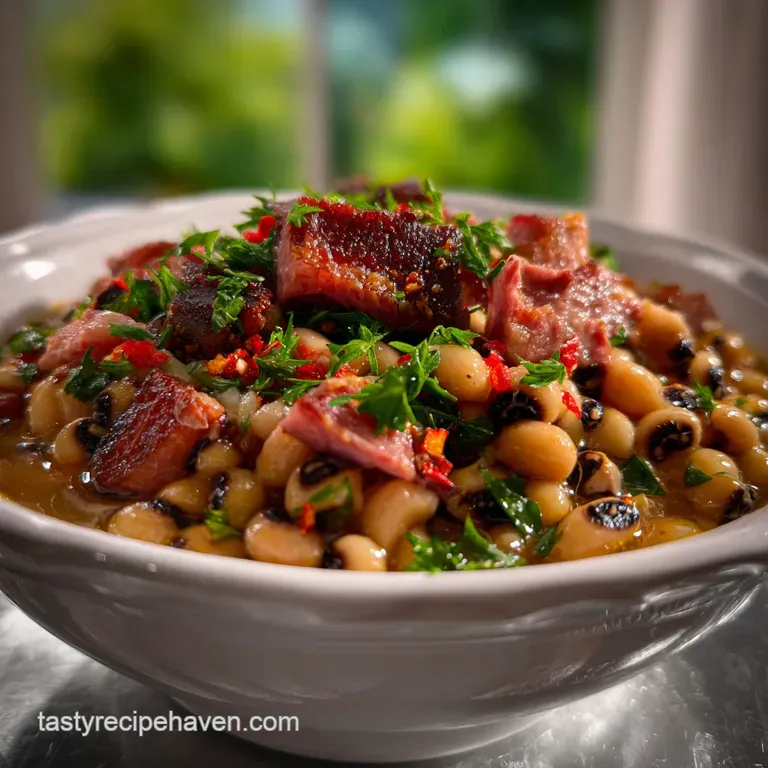
- Effort/Time: Low-active effort; 2 hour total duration.
- Flavor Hook: Deeply savory umami bomb with subtle cayenne heat.
- Perfect for: New Year’s Day traditions or Sunday make-ahead meal-prep.
- The Molecular Mechanics of Smoke and Starch Infusion
- The Molecular Mechanics of Smoke and Starch
- Thermal Benchmarks and Quantitative Performance Metrics
- The Essential Element Map for Deep Flavor Depth
- The Technical Toolset for Heat Retention and Osmosis
- The Systematic Execution of Flavor Layering and Simmering
- Addressing Structural Failures and Correcting Imbalanced Pot Likker
- Adaptive Frameworks for Dietary Needs and Global Flavor Profiles
- ⚗️ The Scaling Lab: The Physics of Quantity
- Common Myths Regarding Black Eyed Peas Recipes
- Preservation Protocols and Thermal Recovery for Long-Term Storage
- Harmonizing Textures and Balancing Acid for the Perfect Southern Plate
- Recipe FAQs
- 📝 Recipe Card
The Diamond Hook
There is nothing more disheartening than spending two hours and a significant grocery budget on a pot of beans only to find the peas are gritty and the ham hocks haven't released their essence.
I’ve witnessed home cooks dump entire batches of Southern Black Eyed Peas Recipes down the drain because the texture was reminiscent of gravel while the broth remained watery and flavorless.
A texture failure isn't just a waste of a 1 lb bag of dried peas; it’s the loss of the expensive smoked meats and the hours spent tending the stove.
I’ll be the first to admit I’ve ruined my share of Southern Black Eyed Peas Recipes by trying to rush the hydration phase. Early in my cooking journey, I once served a batch that was so aggressively undercooked the guests were essentially eating smoky buckshot.
I thought higher heat would compensate for a skipped soak, but thermodynamics had other plans the outside turned to mush while the interior remained a starchy, chalky brick. It was an embarrassing lesson in the necessity of patience and the physics of legume cell walls.
The secret to a "shatter-on-the-tongue" texture isn't a secret ingredient; it’s the scientific understanding of collagen hydrolysis and pectin breakdown. By using a Lodge Enameled Cast Iron Dutch Oven to maintain steady thermal mass and incorporating 2 large smoked ham hocks, we trigger a slow release of gelatin that creates a velvety, lip-smacking broth.
This isn't just cooking; it’s a controlled chemical reaction that turns tough connective tissue and dried seeds into a mahogany colored masterpiece of Southern comfort.
The Molecular Mechanics of Smoke and Starch Infusion
The success of Southern Black Eyed Peas Recipes relies on the interplay of heat, salt, and time to manipulate the physical structure of the legume.
- Collagen Hydrolysis: Smoked ham hocks contain high levels of collagen which, when held at a simmer, transform into gelatin, providing the "pot likker" with its signature viscous, velvety mouthfeel.
- Pectin Softening: The addition of 6 cups high-quality chicken stock provides the necessary liquid for the bean’s pectin cell walls to hydrate and soften without disintegrating into a paste.
- Maillard Reaction: Sautéing 4 oz salt pork and 1 large yellow onion in 2 tbsp bacon fat creates a foundational layer of aromatic complexity that permeates the permeable skin of the peas.
- Osmotic Pressure Management: Controlled seasoning with Diamond Crystal Kosher Salt ensures the skins remain tender; adding too much salt too early can occasionally toughen the exterior of certain legume varieties.
The Molecular Mechanics of Smoke and Starch
The Science of Gelatin Extraction
The "pot likker" or broth in Southern Black Eyed Peas Recipes isn't just water; it’s a complex emulsion. By simmering 2 large smoked ham hocks for nearly two hours, you are physically breaking down triple helix collagen fibers into individual gelatin strands.
This gelatin increases the viscosity of the liquid, allowing it to coat the peas and your palate. This is why the broth feels "thick" even without added starch or flour.
Controlled Hydration for Better Digestion
Dried black eyed peas are packed with oligosaccharides complex sugars that the human body struggles to break down. A proper rinse and sorted preparation of 1 lb dried black eyed peas helps remove surface starches and dust.
During the simmer, the heat allows water to penetrate the hilum (the "eye" of the pea), slowly expanding the starch granules inside until they are soft and digestible, rather than explosive and gas-producing.
Layered Aromatic Foundation
We don't just boil; we build. By starting with 2 tbsp bacon fat and 4 oz salt pork, we create a fat-soluble base for the 1 tsp smoked paprika and 1/2 tsp cayenne pepper. Many flavor compounds in spices are hydrophobic, meaning they don't dissolve well in water.
By "blooming" them in the rendered pork fat before adding the 6 cups high-quality chicken stock, you ensure the spice is distributed evenly throughout the entire pot of Southern Black Eyed Peas Recipes.
Thermal Benchmarks and Quantitative Performance Metrics
| Metric | Value |
|---|---|
| Recipe Yield | 8 servings |
| Prep Time | 15 minutes |
| Cook Time | 1 hour 45 mins |
| Total Time | 2 hours |
| Optimal Simmer Temp | 185°F - 200°F (85°C - 93°C) |
The Essential Element Map for Deep Flavor Depth
| Ingredient | Chemical/Physical Role (Science) | The Pro Secret (Why This Matters) |
|---|---|---|
| 1 lb Dried Black Eyed Peas | Starch gelatinization and protein source | Sorting is vital; one stray pebble can literally crack a tooth. |
| 2 Smoked Ham Hocks | Collagen hydrolysis/Gelatin source | The smoke particles (phenols) provide a preservative and flavor masking depth. |
| 4 oz Salt Pork | Saturated fat rendering | Adds a "slick" mouthfeel that carries the heat of the cayenne. |
| 4 Cloves Garlic | Allicin release and aromatic sulfur compounds | Minced garlic releases more pungent enzymes than whole cloves, cutting through the heavy fat. |
- 1 lb dried black eyed peas, sorted and rinsedWhy this? Dried beans offer superior texture and "bite" compared to mushy canned versions.
- 6 cups high-quality chicken stockWhy this? Provides a deeper savory base than plain water, enhancing the umami profile.
- 2 large smoked ham hocks (approx. 1 lb)Why this? The primary source of both smoky flavor and thickening gelatin.
- 2 tbsp bacon fat
- 4 oz salt pork, diced
- 1 large yellow onion, finely diced
- 2 stalks celery, diced
- 1 green bell pepper, diced
- 4 cloves garlic, minced
- 2 dried bay leaves
- 1 tsp smoked paprika
- 1/2 tsp cayenne pepper
- Kosher salt to taste
- Freshly cracked black pepper to taste
The Technical Toolset for Heat Retention and Osmosis
- Lodge 6 Quart Enameled Cast Iron Dutch Oven: The heavy walls provide consistent thermal mass, preventing the temperature fluctuations that lead to unevenly cooked beans.
- Stainless Steel Fine Mesh Strainer: Essential for the "sort and rinse" phase to ensure no debris remains.
- Wooden Spoon or over High heat Silicone Spatula: For scraping the "fond" (browned bits) off the bottom of the pot after sautéing the aromatics.
- Digital Instant Read Thermometer: To ensure the simmer stays below a rolling boil (approx 195°F).
The Systematic Execution of Flavor Layering and Simmering
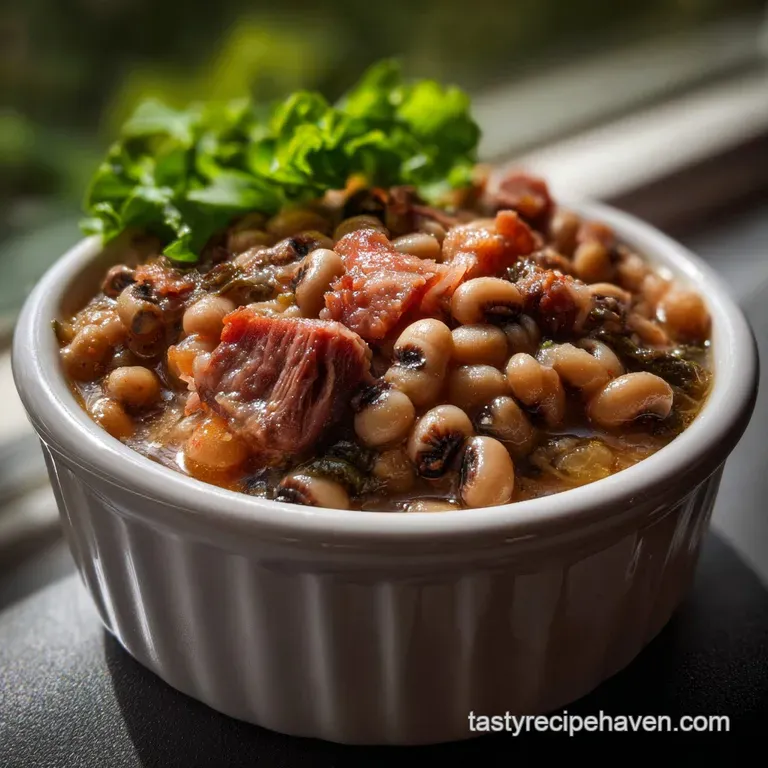
- Sort the 1 lb dried black eyed peas. Note: Remove any stones, shriveled beans, or debris that could ruin the texture.
- Rinse the peas under cold running water in a mesh strainer. Note: Removes surface dust and excess starch that can make the broth cloudy.
- Sauté the 4 oz diced salt pork and 2 tbsp bacon fat in the Dutch oven over medium heat for 8 mins until the pork is browned and the fat has rendered.
- Add the 1 large yellow onion, 2 stalks celery, and 1 green bell pepper. Note: This "Holy Trinity" creates the aromatic backbone of the Southern Black Eyed Peas Recipes.
- Cook the vegetables for 6 mins until the onions are translucent and the pepper is fragrant.
- Stir in the 4 cloves minced garlic, 1 tsp smoked paprika, and 1/2 tsp cayenne pepper. Note: Sautéing spices in fat (blooming) intensifies their flavor molecules.
- Pour in the 6 cups high-quality chicken stock and add the 2 large smoked ham hocks. Note: Liquid must completely submerge the hocks to begin the collagen breakdown.
- Incorporate the rinsed peas and 2 dried bay leaves into the pot. Note: Ensure the peas are fully submerged to prevent uneven hydration.
- Simmer the mixture on low heat for 1 hour 30 mins until the peas are tender and the ham is falling off the bone.
- Season with Diamond Crystal Kosher Salt and black pepper to taste. Note: Always season at the end, as the liquid reduces and flavors concentrate.
Chef's Tip: For an ultra creamy pot likker, take one ladle of the cooked peas and mash them against the side of the pot or in a small bowl, then stir them back in. The released starches act as a natural thickener.
Addressing Structural Failures and Correcting Imbalanced Pot Likker
If your Southern Black Eyed Peas Recipes don't turn out perfectly, it’s usually a matter of thermal control or acidity balance. If you find the peas are still hard after the allotted time, it is often due to "hard water" or old beans.
Calcium in hard water can bind to the pectin in the bean skins, preventing them from softening.
For another Southern classic that relies on over high heat precision, check out my Soft Shell Crab Recipes to master the ultimate crispy exterior.
Beans are Still Hard
This usually happens because the simmer wasn't consistent or the beans were aged. Older dried beans lose moisture over time and require significantly longer cooking windows.
Too Much Liquid (Thin Broth)
If your Southern Black Eyed Peas Recipes look more like a clear soup than a rich stew, you likely didn't have enough surface evaporation or the hocks were too small.
| Problem | Root Cause | The Fix | Pro Protocol |
|---|---|---|---|
| Crunchy Centers | Thermal mass was too low or time was insufficient | Simmer for an additional 20 mins with a lid on | Use a heavy cast iron pot to keep heat stable |
| Bland Broth | Lack of Maillard reaction in the aromatics | Stir in 1 tsp of apple cider vinegar and more salt | Always brown your salt pork until it's mahogany brown |
| Shattered Beans | Violent rolling boil destroyed the skins | Lower heat immediately and add a splash of cold stock | Maintain a "lazy bubble" (approx 190°F) for the entire cook |
Adaptive Frameworks for Dietary Needs and Global Flavor Profiles
Vegetarian/Vegan Southern Style
To achieve the depth of Eyed Peas Recipes without the pork, substitute the bacon fat with avocado oil and the chicken stock with a high-quality vegetable broth. Add 1 tsp of liquid smoke and 1 tbsp of soy sauce (umami booster) to replace the ham hock's profile.
Slow Cooker (Crockpot) Conversion
If using a slow cooker for Black Eyed Peas Recipes, reduce the chicken stock by 1 cup (as there is zero evaporation). Sauté the aromatics in a pan first, then transfer everything to the crockpot and cook on Low for 6 8 hours.
| Original Ingredient | Substitute | Why It Works |
|---|---|---|
| Ham Hocks (2) | Smoked Turkey Wings (1 lb) | Similar smoky profile with lower fat content. Note: Skin is thinner. |
| Salt Pork (4 oz) | Thick cut Bacon (4 strips) | Provides the same smoky fat rendering and salty bite. |
| Chicken Stock (6 cups) | Beef Bone Broth (6 cups) | Adds a much darker, richer color and heavier mouthfeel. |
⚗️ The Scaling Lab: The Physics of Quantity
When you are doubling your Southern Black Eyed Peas Recipes for a large gathering, you cannot simply double everything and expect the same results.
- The Evaporation Paradox: If you double the recipe in the same wide pot, you have doubled the volume but kept the surface area the same. Reduce the chicken stock by 15% (use approx 10 cups instead of 12) or the broth will be too thin.
- Flavor Saturation: Spices like cayenne and smoked paprika scale non-linearly. Only use 1.5x the spices when doubling the beans. You can always add more at the 1 hour 45 min mark.
- Thermal Mass: Doubling the cold ingredients in one pot will significantly drop the temperature. It will take 20 30 minutes longer just to reach a simmer. Factor this into your timeline.
- Batch Sautéing: Do not try to brown 8 oz of salt pork in one go. The pot will lose heat, and the meat will steam instead of sear. Sauté in two batches to ensure the Maillard reaction occurs.
Common Myths Regarding Black Eyed Peas Recipes
- Myth: You must soak black eyed peas overnight.
- Truth: Unlike kidney beans, black eyed peas are small and relatively thin skinned. A "quick soak" or even no soak (as used in this recipe) works perfectly, provided you simmer them for the full 1 hour 45 mins.
- Myth: Salt makes beans tough.
- Truth: This is a half truth. While very high salt concentrations can slow the softening of skins, a moderate amount of salt in the cooking liquid actually helps the beans cook more evenly by displacing magnesium in the cell walls.
Preservation Protocols and Thermal Recovery for Long Term Storage
Southern Black Eyed Peas Recipes actually taste better on day two because the starches and fats have time to emulsify further in the fridge.
- Fridge: Store in an airtight container for up to 5 days. The gelatin in the broth will cause it to set into a jelly like consistency when cold; this is a sign of a perfect pot likker.
- Freeze: These freeze beautifully for up to 6 months. Leave 1 inch of headspace in your freezer bag to allow for liquid expansion.
- Reheating: Reheat on the stovetop over medium low heat. Add a splash of water or stock to loosen the gelatinous broth back into a liquid state.
💡 ZERO WASTE PHILOSOPHY Don't discard those ham hock bones! Transform: After pulling the meat for the peas, simmer the bones again with vegetable scraps for a "second run" smoky stock.
Science: Even after the first simmer, the marrow and deep connective tissues still hold significant mineral content and flavor.
Harmonizing Textures and Balancing Acid for the Perfect Southern Plate
To serve Southern Black Eyed Peas, pair them with a side of hot cornbread to soak up the pot likker. The sweetness of the corn balances the saltiness of the pork. For a lighter pairing, these peas work exceptionally well alongside Lamb Burger Recipes, where the earthy flavor of the lamb complements the smoky legumes.
Always finish the bowl with a dash of hot sauce or a teaspoon of apple cider vinegar. The acetic acid in the vinegar cuts through the heavy 16.8 g of fat per serving, brightening the entire dish and making the smoky notes pop. If you're looking for a sweet finish after such a savory meal, these Small Batch Cookie Recipes are the perfect way to round out a Sunday dinner without making a massive mess.
Trust me, once you master the science of the simmer and the layering of these Southern Black Eyed Peas Recipes, you’ll never go back to the canned stuff again. Let’s crack on and get that pot bubbling.
Recipe FAQs
How to make southern black eyed peas?
Sauté aromatics, add peas and smoked hocks, then simmer gently for 1.75 hours. Always sauté the salt pork and vegetables first to build a hydrophobic flavor base before adding liquid. This layered technique ensures maximum depth in the final broth, called pot likker.
Is soaking black eyed peas necessary before cooking?
Myth: Soaking is mandatory for tender peas. Reality: Soaking is optional for black eyed peas due to their smaller size and thinner skin. Extended simmering compensates for a lack of pre-soak, though soaking can reduce cooking time slightly.
What is the difference between cooking peas with ham hocks versus bacon?
Ham hocks provide gelatin and body. Bacon primarily offers rendered fat and a smoky flavor layer, but lacks the necessary high collagen content to create the signature thick, velvety pot likker from collagen hydrolysis.
Why are my black eyed peas gritty or undercooked after 2 hours?
Inconsistent simmering temperature caused uneven cell wall hydration. If the temperature drops too low, the pectin remains rigid; if it boils too hard, the exterior disintegrates before the center softens.
- Ensure the liquid is just barely bubbling
- Use a heavy Dutch oven for thermal stability
- Avoid adding acid (like vinegar) until the final 15 minutes
Can I use dried beans instead of canned for authentic flavor?
Dried beans yield significantly better texture and flavor depth. Canned peas often possess a mushy texture because they are already fully hydrated and cooked under pressure. If you enjoyed the technique of blooming spices in fat here, you can apply that exact principle to enhance flavor when preparing Dal Makhani Recipe: Authentic Punjabi Black Lentil Curry.
Should I salt the peas at the beginning or the end of cooking?
Salt should be added toward the end of the cooking process. While the old rule is disputed, adding high concentrations of salt too early can sometimes slightly slow the hydration rate of the pectin in the skins, leading to slightly firmer exteriors.
What is the key technique to prevent watery, thin pot likker?
Collagen breakdown from the smoked meat is the primary thickener. Ensure your ham hocks simmer long enough for the connective tissue to fully break down into gelatin, which thickens the liquid naturally; for added body, mash a small portion of cooked peas back into the broth.
Velvety Southern Black Eyed Peas